
We'll help you make a smart co-ownership investment by avoiding costly legal disputes, hidden liabilities, and ownership structure mistakes before you buy.

Smooth transaction with limited risk
No pressure to over pay and buy within a certain time period
A team of people that will be with you even after the transaction is complete
Purchasing property as two or more individuals in New York City is one of the smartest strategies available to buyers who want to break into one of the world's most competitive housing markets-but only when it's structured correctly from day one. I'm Stanley Montfort, and I've spent years helping co buyers navigate the financial, legal, and interpersonal complexities of shared ownership purchases across every borough. Whether you're friends pooling resources for a Brooklyn condo, a parent helping an adult child buy their first co op, or investment partners acquiring rental property, I guide you through every decision so your co-ownership arrangement is built to last.
New York City real estate has a well-earned reputation for high barriers to entry. Between steep down payment requirements, intense competition for desirable units, and the financial scrutiny of co op boards, many qualified buyers find themselves priced out when purchasing alone. Co-ownership changes that equation.
When I sit down with prospective buyers considering a co purchase, I walk them through the core advantages that make shared ownership compelling in this market:
That said, I always tell clients: co-ownership only works when the planning matches the ambition. Choosing the right ownership structure is crucial in real estate co-ownership. Without a thorough co ownership agreement, clear exit strategies, and proper legal documentation, even the strongest relationships can fracture under the pressure of shared real property obligations.
One of the most common scenarios I encounter involves friends or siblings who want to combine their resources to purchase their first NYC property together. Maybe two college friends have been renting in Astoria for years and realize they could afford a condo in a neighborhood they love if they buy together. Or siblings want to invest in a property near aging parents.
When helping friends and family structure a co purchase, I focus on building ownership agreements that account for unequal financial contributions, different timelines, and the reality that relationships evolve. A mistake I frequently see buyers make is assuming that because they trust each other, they don't need formal documentation. They do-always.
For unmarried couples, owning property together requires careful thought about what happens if the relationship changes. Unlike married couples, who have legal protections built into divorce proceedings, unmarried co owners must rely entirely on their co ownership agreement to define rights, responsibilities, and exit paths.
I help couples choose the ownership structure that protects both parties' interests while building shared equity. That means discussing everything from ownership percentages to what happens if one partner wants to sell and the other doesn't.
Parents helping adult children purchase in New York City is increasingly common, and the financial and tax implications deserve serious attention. Understanding how ownership affects estate planning is important in co-ownership arrangements-who holds the property title, how ownership interest is divided, and whether the arrangement creates gift tax or inheritance consequences all matter.
I work with both generations to structure arrangements that accomplish their goals: getting the child into a home while protecting the parent's investment and planning for what happens when the parent eventually wants to exit or when an owner dies.
When business partners or investors are purchasing property together-whether it's a rental unit in Washington Heights or a multi-family brownstone in Bed-Stuy-the stakes are different. Investment property co-ownership often works best through LLC ownership, where a limited liability company holds title and an operating agreement governs decisions, profits, and exits.
I guide investment partners through entity formation, property selection, financing, and the operational realities of managing shared real estate with multiple owners.
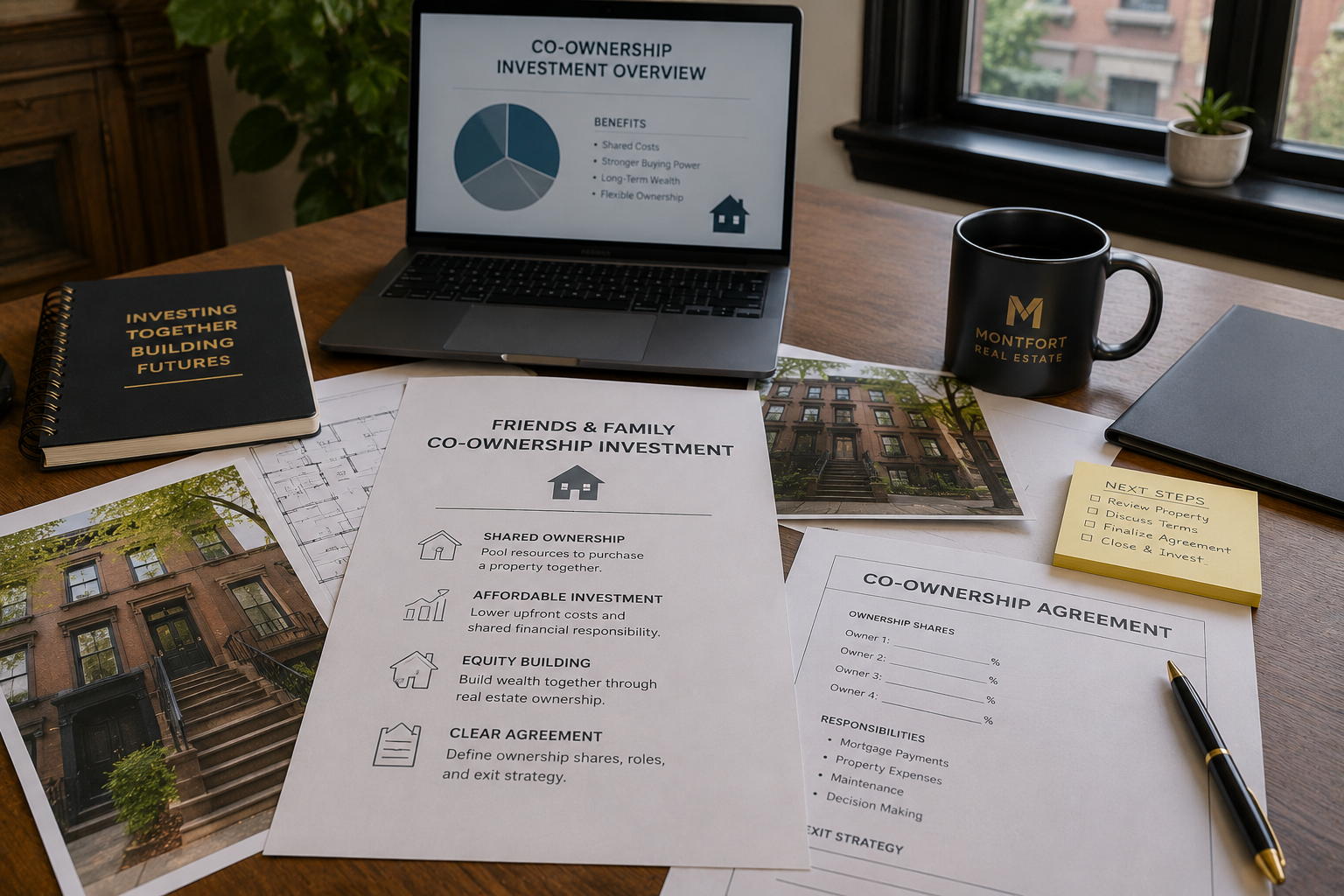
One question I always encourage clients to discuss early is which ownership structure best fits their situation. The structure you choose determines your ownership rights, what happens when an owner dies, how you can exit, and how creditors can reach the property. Here's what you need to know:
| Structure | Ownership Flexibility | Survivorship | Best For | Key Considerations |
|---|---|---|---|---|
| Tenants in Common (TIC) | Unequal ownership shares allowed | No; ownership passes by will or estate | Friends, siblings, or buyers with unequal contributions | Requires buyout provisions and right of first refusal clauses |
| Joint Tenancy | Equal ownership shares required | Yes; automatic right of survivorship | Committed couples and long-term partners | Requires explicit deed language |
| Tenancy by the Entirety | Equal ownership shares | Yes; automatic right of survivorship | Married couples | Provides creditor protection; terminates upon divorce |
| LLC Ownership | Defined by the operating agreement | Specified in the operating agreement | Investors, multiple owners, and complex ownership structures | Entity formation costs; co-op board acceptance may vary |
| Shared-Equity / Affordable Co-op | Defined by the housing program | Varies by program | Income-qualified households | Resale restrictions and occupancy requirements |
Before we look at a single listing, I sit down with all prospective buyers to have the conversation that matters most. One of the first conversations I have with co buyers is about exit strategy-very few people think about what happens if one partner wants out in five years. That gap causes most bitter disputes.
In this session, we cover each buyer's financial capacity: credit scores, debt to income ratio, savings, income documentation, and monthly budget for carrying costs. We discuss long-term goals-how long each person intends to stay, whether the property will serve as a primary residence or investment property, and inheritance wishes.
We also identify the optimal ownership structure and begin outlining what will go into the co ownership agreement. Key factors we address include:

With the strategy defined, I target buildings and neighborhoods that welcome co owners. Not every building is equally receptive to shared ownership arrangements.
In NYC, cooperative purchasers buy shares in a corporation rather than direct property ownership, and co op boards have strict approval processes for buyers. Co-ops make up about 75% of NYC's housing stock, so understanding the board approval process is essential. I review each building's proprietary lease, bylaws, financial statements, underlying mortgage, and reserve levels before recommending a property.
Condominium buyers own their units directly through deeds, and condo ownership typically involves fewer restrictions than co-ops. Condos generally offer more flexibility for co-ownership arrangements, though they typically cost more-co-ops generally cost 15-20% less than condos in NYC.
For co-ops, I analyze:
For condos, I review HOA financials, shared cost provisions, and any restrictions from condo boards that might affect co-ownership.
When helping buyers purchase together, I structure offers that address the unique complexities of co-ownership. This means specifying all names on the property title or share certificates, clarifying who pays what, and including provisions for co-owner default or death.
I negotiate contract terms that protect all buyers' interests-including minority or non-mortgage-holding co owners. Before making an offer, I require that a co ownership agreement be drafted as a condition of purchase, not something handled after closing. This agreement defines:
I coordinate closely with each buyer's experienced real estate attorney to ensure every document reflects the agreed terms.
At closing, I ensure that deed or share certificates correctly reflect the chosen ownership structure-whether that's joint tenants, tenants in common, or LLC ownership. Mortgage documents name all co borrowers where required. Title insurance, hazard insurance, and funds are handled properly.
For co-op purchases, I prepare all buyers for the board package submission and board interview. Co op boards scrutinize financial documents, personal references, and professional history, and when multiple owners are involved, every applicant must meet the building's financial requirements.
Post-closing, I help co owners establish systems for managing shared responsibilities: how maintenance costs are tracked, how decisions about repairs and capital improvements are made, and how operating costs are divided. Many buyers assume the hard part is over at closing-but co-ownership is an ongoing relationship that requires clear communication.
"Stanley walked us through every scenario before we even started looking at apartments. When my best friend and I bought our Brooklyn condo together, we already had a buyout agreement and exit plan in place. Three years later, we're building equity and still great friends."
- Michelle T. & Dana R., Brooklyn Condo Co-Owners
"My mother helped me buy a co-op on the Upper West Side. Stanley structured the ownership so that inheritance planning was handled from day one. The board interview prep alone was worth it-we sailed through approval."
- James L., Upper West Side Co-Op Owner
"As an unmarried couple buying in Tribeca, we had a lot of anxiety about protecting our individual interests. Stanley connected us with an experienced real estate attorney and made sure our co ownership agreement covered every contingency. We couldn't have done this without him."
- Sarah K. & Michael P., Tribeca Co-Owners
This is the question that keeps me up at night on behalf of my clients-because without a plan, it can destroy both the investment and the relationship.
If your co ownership agreement includes a buyout clause, the process is straightforward: the remaining owners have the right of first refusal to purchase the departing co owner's ownership interest at a price determined by an agreed formula. In the Phillip v. Zanani case, two New York co-owners had an agreement specifying that each party would obtain an independent appraisal, the values would be averaged, the outstanding mortgage subtracted, and the departing owner would receive their proportional share of net equity.
Without such an agreement, a co-owner can sell their share without consent from others-or worse, file a partition lawsuit to force a sale. Partition lawsuits can take 12 to 18 months to resolve, and the outcome rarely benefits anyone. In Leonardo v. Leonardo II, the court enforced a partnership agreement that restricted partition rights, demonstrating that well-drafted ownership agreements hold up in court.
Co-owners are jointly liable for the mortgage payments regardless of ownership share. Even if one owner defaults on their contribution, mortgage payments must be made even if one owner defaults-the lender doesn't care about internal arrangements between co owners.
Yes, but it requires careful structuring. Many buyers assume all co owners must be on the mortgage, but that's not always the case. One person may hold the mortgage while other co owners contribute through a separate reimbursement arrangement documented in the co ownership agreement.
However, there are risks. The mortgage-holding co owner bears full legal responsibility for payments, and lenders assess eligibility based on the lowest credit score and weakest debt to income ratio among co borrowers if all parties are on the loan. Pooling resources improves mortgage approval chances for higher-priced properties, but each co owner's financial profile matters.
Generally speaking, I recommend getting pre-approved early and discussing options with lenders who have experience with co-ownership financing. Mortgage interest deductions and capital gains implications should be discussed among co-owners and their tax advisors before closing.

No. This is one of the key factors I evaluate before recommending any property.
Co op boards have significant authority over who can purchase shares. Some co op building policies explicitly address multiple owners, while others evaluate each applicant individually against the building's financial requirements. The board approval process for co-ops typically involves extensive review of financial documents, tax returns, bank statements, and personal references for every buyer.
Condo boards generally have less authority over purchases, but may still have policies regarding co-ownership. Condos typically allow more flexibility, making them a better fit for some co-ownership arrangements.
I identify co-ownership-friendly buildings early in the search process so clients don't waste time pursuing properties where board approval is unlikely.
At minimum, co owners need:
Co-owners can face disputes over property expenses, and disputes often arise over renovations and property management. Having comprehensive written agreements dramatically reduces the risk of costly property disputes. I strongly recommend working with an experienced real estate attorney who specializes in co-ownership and co-op transactions.
Co-owners are jointly and severally liable for the mortgage, meaning each person is individually responsible for the full amount if other owners fail to pay. This reality makes proper legal documentation not optional-it's essential.
Successful co-ownership begins long before you start browsing listings. It starts with an honest conversation about finances, goals, relationships, and what happens when life doesn't go according to plan.
If you're considering purchasing property with a friend, family member, partner, or investment colleague in New York City, I'd like to sit down with you and your co buyers to evaluate whether shared ownership is the right strategy for your situation. Every co-ownership arrangement I help structure is tailored to the specific people involved-there's no template that works for everyone.
Phone: 1-646-970-1078 Email: sm@montfortre.com Address: 8 West 126th Street, New York NY 10027
Whether you're exploring your first co purchase or structuring a complex investment partnership, the right guidance from the beginning protects your investment, your equity, and your relationships. Let's talk about what co-ownership could look like for you.
Loading live Google reviews…
Stay in the loop on the latest events, news, & happenings in and around our community!

On the Upper West Side, we observed a distinct trend that diverges from the citywide patterns. Speci…

The Harlem brownstone market has seen an increase in sales activity since this time last year. In Q2…

Are you searching for your dream home in one of New York City’s most sought-after neighborhoods? Loo…
Reach out for buyer representation, listing strategy, or a confidential valuation with Stanley Montfort.
