Rental Income
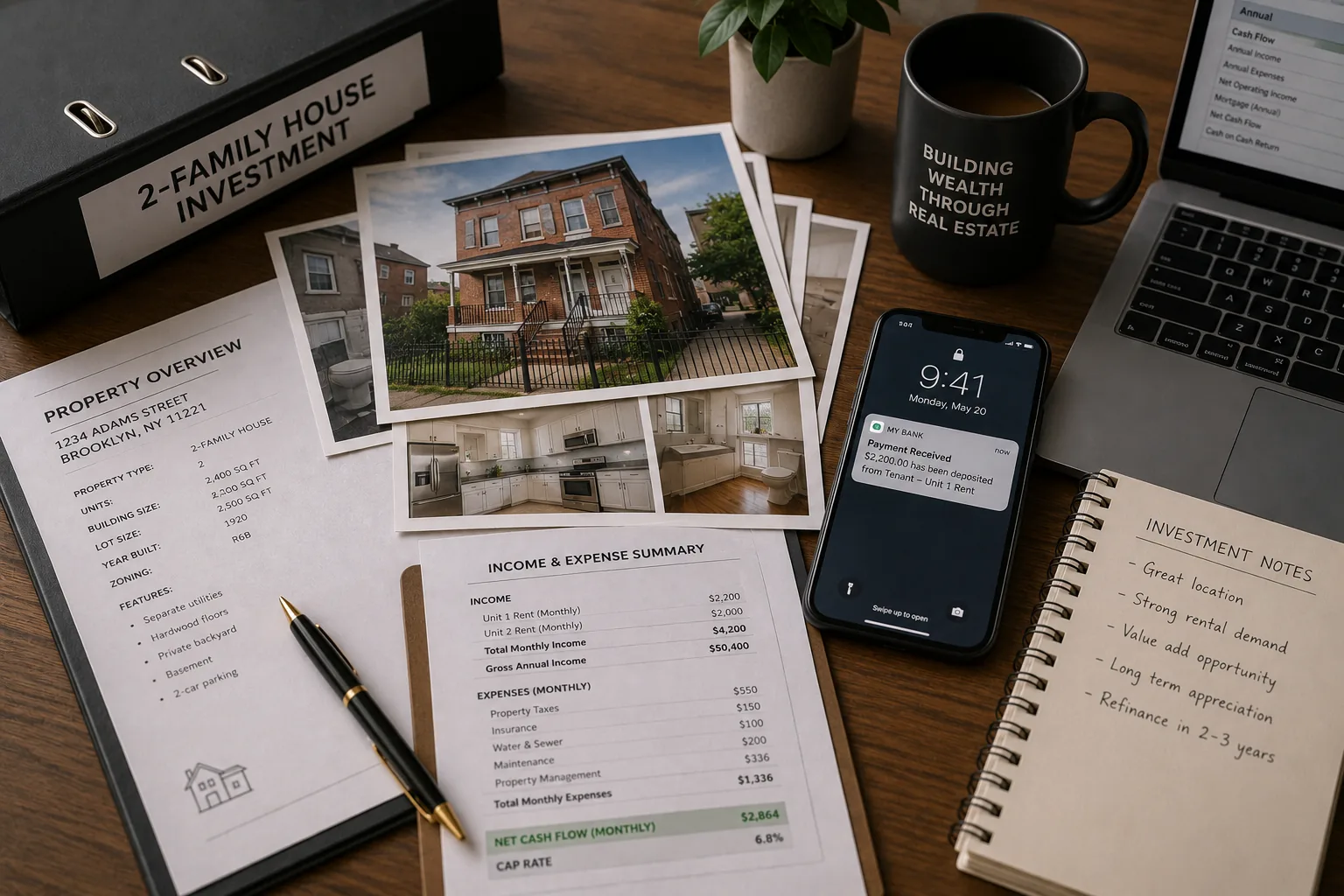
Tenants help offset mortgage, taxes, insurance, and operating expenses.

Condo vs brownstone
Compare the true monthly cost and long-term financial impact of buying a condo versus an owner-occupied 2–4 unit NYC brownstone.
Smooth transaction with limited risk
No pressure to over pay and buy within a certain time period
A team of people that will be with you even after the transaction is complete
Condo vs. brownstone
A condo and a brownstone can have dramatically different ownership economics. With a 2–4 unit property, rent from the additional apartments can help pay your mortgage while you build equity in the entire building—not just a single apartment. Enter your numbers below to compare true monthly cost and long-term equity.
Total monthly carrying cost
After $6,650/mo net rent
Condo
Brownstone
Condo
Brownstone
Over 10 years, brownstone equity is $670,015 higher than the condo on these assumptions.
“The brownstone in this scenario costs $1,000,000 more than the condo, but after receiving approximately $6,650/mo in net rental income, your effective monthly housing cost is actually $903 lower.”
Your tenants could cover approximately 40% of your monthly brownstone property carrying expenses.
Tenants help offset mortgage, taxes, insurance, and operating expenses.
You own the entire building and lot — not just a single apartment.
Growth compounds on the full multi-family structure value.
No condo common charges or condo-board budget restrictions.
List price alone can be misleading. A brownstone may cost more up front, yet after collecting net rent from the other units your effective monthly housing cost can be lower than a condo with high common charges. Conversely, weak rents or heavy operating costs can favor the condo. The calculator on this page is built to surface that tradeoff clearly.
Your tenants help offset mortgage principal, interest, property taxes, building insurance, and operating expenses.
Instead of building equity in a single apartment, you own the entire building, land, and lot—creating a larger base for appreciation.
When the property appreciates, that growth compounds on the total value of the multi-family structure, not just one unit.
There are generally no condo common charges or condo-board restrictions controlling your monthly budget the way co-ops and condos often do.
True monthly cost: For the condo, add mortgage P&I, taxes, common charges / HOA, insurance, and a maintenance reserve. For the brownstone, add P&I, taxes, building insurance, maintenance reserve, and owner-paid utilities—then subtract net rental income after vacancy.
Long-term equity: Switch the horizon between 5 and 10 years to compare projected property value, remaining mortgage, principal paid down, appreciation, cumulative net rent (brownstone), and owner equity. A higher monthly payment can still win if it builds substantially more equity over time.
Rental leverage: The tenant-coverage percentage estimates how much of the brownstone's carrying costs rent can offset. Even partial coverage changes the affordability conversation versus a condo where you pay 100% of carrying costs yourself.
We specialize in helping NYC buyers identify 2–4 unit townhouses where rental income can meaningfully offset the true cost of ownership. Share your calculator assumptions and we will help you find properties that fit the math—not just the listing photos.
Book a strategy call or see available brownstones.
Yes. If net rent from the other units is strong enough, effective out-of-pocket cost can undercut a condo with high common charges—even when the brownstone's purchase price is higher.
Mortgage principal & interest, property taxes, common charges / HOA, homeowners insurance, and an annual maintenance reserve percentage converted to a monthly amount.
Mortgage P&I, taxes, building insurance, maintenance reserve, owner-paid utilities, then an offset for net rental income after vacancy. Closing costs and appreciation assumptions feed the equity projection.
No. Results are educational estimates based on the assumptions you enter. Actual financing, rents, expenses, appreciation, and tax treatment vary. Consult mortgage, legal, tax, and financial professionals before buying.
This calculator is provided for educational and illustrative purposes only. Results are estimates based on the assumptions entered and are not a guarantee of future performance, property appreciation, rental income, financing terms, operating expenses, or investment returns.
Explore the other calculators to pressure-test closing costs, rent vs buy, and ownership choices.

Estimate monthly payment, taxes, and carrying costs before you make an offer.
Open calculator →
Project transfer taxes, attorney fees, and total cash needed to close.
Open calculator →
See net proceeds after commissions, transfer taxes, and seller fees.
Open calculator →
Compare the long-term cost of renting versus owning a brownstone.
Open calculator →Reach out for buyer representation, listing strategy, or a confidential valuation with Stanley Montfort.